
Use Cases and Reactor Types
Sustainable Power for Decarbonization
Advanced nuclear energy can be a key ingredient in 21st century decarbonization. It can help the United States and high emitting countries meet their 2050 climate goals while also sustainably powering emerging economies alongside other clean energy sources.
In order for advanced nuclear to play this role, private industries and governments must work together to research, develop, and manage new technologies while improving upon the past. Industry, academia, government laboratories, public-private partnerships, and independent nuclear safety regulators create a complementary innovation ecosystem.
Nuclear energy provides over half of the United States’ clean electricity. The U.S. Navy has used nuclear propulsion for decades but commercial maritime use has been limited. Meanwhile, radioisotope power systems powered the Apollo, Voyager, Mars, and New Horizons missions. Nuclear energy is used in non-electric applications as well, including to produce heat for residential, commercial, and industrial use in some countries. It has the potential to contribute to decarbonization of the industrial sector and to produce hydrogen for non-emitting transportation.
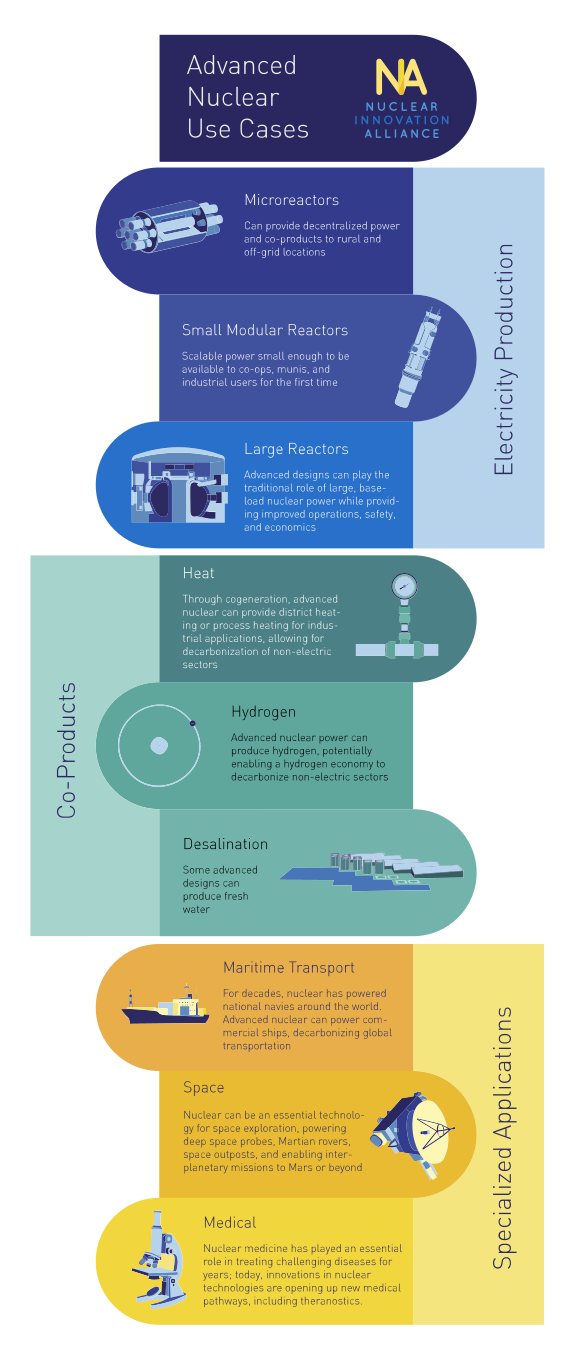
The emerging advanced nuclear energy industry is embracing and expanding upon these use cases. Beyond electricity, new reactor designs can produce co-products to decarbonize other sectors of the economy. Cogeneration can provide district heating or process heat for industry while hydrogen can fuel transportation. Integrated storage systems and improved power output ramping can enable nuclear to balance renewables while providing freshwater through desalination. More innovative forms of advanced nuclear include maritime propulsion to decarbonize the world’s commercial fleet, and powering space reactors for science outposts on the Moon and interplanetary transport to Mars. Nuclear innovation is even benefiting nuclear medicine, with applications such as radionuclide therapy used to treat cancers.
Underlying this renewed and expanded role for nuclear power are new technologies and new models for construction, delivery, and business. Almost all existing commercial nuclear reactors are light-water reactors.
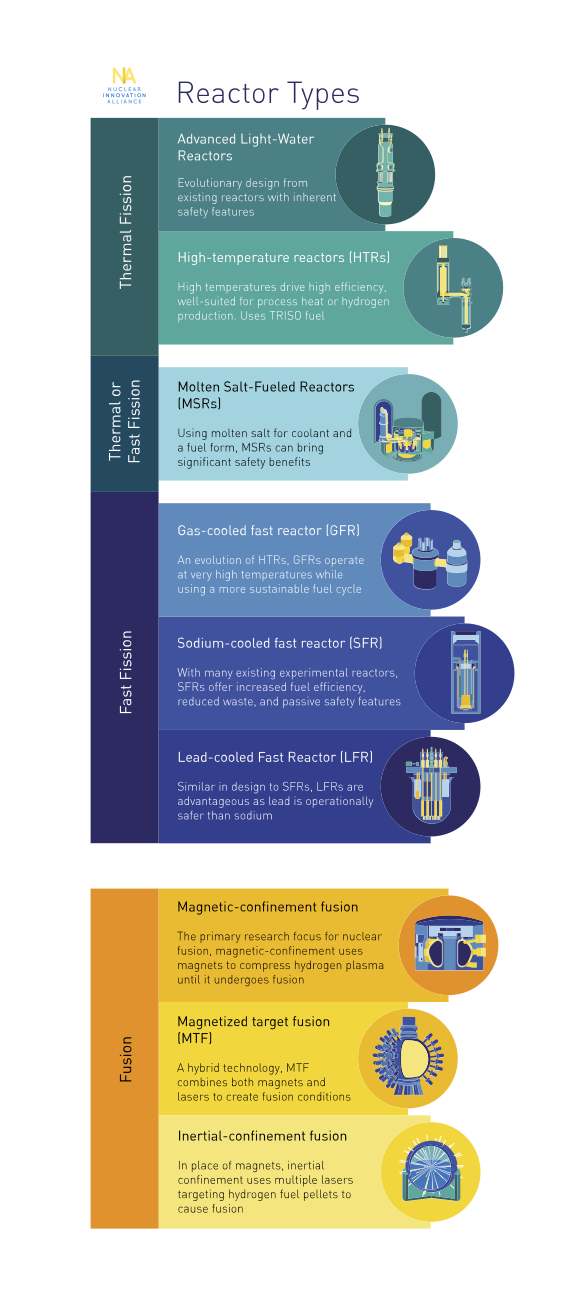
Advanced fission reactors feature safety, business, and fuel cycle innovations through a variety of techniques. These new designs achieve improvements through reactor structural designs, new coolants, and alternative fuel forms. With diversity in reactor designs and business models, nuclear technology is poised for a major role in helping economies achieve decarbonization and development goals.
Meanwhile, the first generation of fusion reactors offer the prospect of an entirely new type of power plant. Three major types of fusion reactors offer multiple research pathways, although others are being explored. Long held to be the energy source of the future, private companies and government research activities are working rapidly towards demonstration and commercialization of fusion power.
Innovation
Greater diversity in reactor designs, sizes, and business models increases competition in the sector, which should lead to the best technologies to drive decarbonization. The advent of microreactors and small modular reactors allow nuclear to compete in areas where it never has – remote areas, mining operations, municipal utilities, and industrial users.
Nuclear innovation is enabled by technological advances in multiple fields, including:
- Material technologies enable the use of higher temperature coolants and processes.
- Computing power and artificial intelligence allow the construction of high-detail simulation of new designs and fuel forms.
- Construction innovation, such as modular production techniques and additive manufacturing (3-D printing) lower costs and risks of building new facilities.
Research and private-sector innovation is driving new uses for nuclear and spin-off technologies. Floating nuclear power plants and mobile reactors can offer power for disaster response. The military is looking at nuclear power for resilient, distributed power sources for U.S. bases. In outer space, both government and the private sector are developing space reactors. The government aims to use them to power and heat remote outposts on the Moon and Mars while providing propulsion for interplanetary missions. Meanwhile, commercial nuclear companies are looking to nuclear energy to support space mining, orbital towing, and even fusion propulsion.
Beyond nuclear applications, research projects by the government and private-sector for advanced nuclear are leading to new technologies for other sectors. Company research supports new discoveries in medical science, with improved diagnosis and treatment technologies and new methods to produce medical isotopes. Integrated salt storage can unlock new thermal storage technologies to complement renewable generation. Research in using supercritical CO2 as a working fluid can support the development of carbon capture systems.
Underlying nuclear research and new applications is an emerging innovation ecosystem.